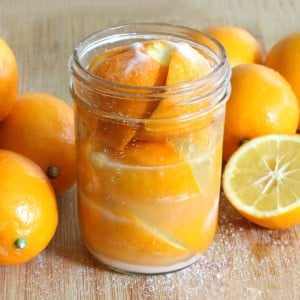
I found this online at The Daring Gourmet...
Preserved lemons are
lemons on steroids. They add an intense, concentrated lemon flavor to the dish without all the sour tartness. The preserving process tempers the tartness while accentuating the lemon flavor. Mildly tart but
intensely lemony.
Preserved lemons are used throughout Morocco, the Middle East and in certain areas of India to add flavor to a variety of dishes – everything from meats to salads, stews and sauces. And really, your imagination is the limit to how they can be used and enjoyed. Here are a few more ideas:
Salad Dressings. Blend some preserved lemon into it and that dressing will love you forever.
Fish. Seafood and lemons are soul mates. Now think about relationship seafood and
preserved lemons can form. Whip up a lovely marinade for your fish with some finely diced or blended preserved lemon or add it to your sauce to drizzle over your fish.
Chicken. Chicken and lemon is a match made in heaven. Add a bit of chopped preserve lemon to your favorite chicken dishes and see what happens.
Djej Makalli (from Morocco) is probably the most famous chicken dish featuring preserved lemons – it’s incredible!
Healthy Grain Dishes and Salads. Think nutty roasted barley or quinoa tossed with vegetables and tiny bits of preserved lemon with a tasty vinaigrette. Or how about a preserved lemon risotto or pilaf?
Pasta. Buttery pasta tossed with a creamy preserved lemon sauce?
Dips. Try adding some preserved lemon to your hummus next time. Or to your
baba ganoush.
Salsas. Next time you make your famous mango/pineapple/however-you-make-it salsa, add some diced preserved lemon to it.
How To Make Preserved Lemons
Prep time
10 mins
Total time
10 mins
Ingredients
- 3 Meyer lemons (or Eureka, Lisbon, etc, organic recommended) per pint-sized jar
- 5-6 teaspoons salt (sea salt or kosher recommended)
- An extra lemon for juicing
- Water that has been boiled and cooled (sterile)
- Trim the nubs off both ends of the lemons
- Slice the lemons into quarters, leaving the ends attached. So slice down just a little over 3/4 of the way.
- Put a teaspoon of salt in the bottom of a pint-sized jar. Put another teaspoon of salt into the quartered lemon.
- Stuff the lemon into the jar, open end down, and push hard to squish it and release its juices.
- Put a teaspoon of salt over the top of the lemon.
- Repeat the process, putting a teaspoon of salt inside the second lemon, and then squish it down hard on top of the first lemon.
- add another teaspoon of salt on top of the second lemon, and repeat the process for the third and final lemon. Add a teaspoon of salt on the very top. The jar should be halfway full of lemon juice from having compressed the lemons. If needed, squeeze some extra lemon juice into the jar to bring it to the halfway point. And don’t waste that lemon – cut it up and stuff it into the jar. Now pour some water that’s been boiled and cooled (sterile) into the jar to fill it up the rest of the way. Repeat this process for however many jars you wish to make.
- After you add the water, screw on the lid and let the jar sit at room temperature for 3 days, giving it a shake and turn it upside-down/right-side up a few times a day. After 3 days place the jar in the refrigerator and let it sit for at least 3 weeks before using. Keep the jar in the refrigerator (It will last for more than 6 months, in the Middle East they don't bother with refridgerators). Whatever dish you use them in, discard the pulp (it’s the peel that is used) and thoroughly wash the peel to remove excess salt.



 Wasn't anything like what you have there -- just a few cherry tomatoes.
 That is reassuring for 2018.

 Yeah, RIGHT!!!! It was just a way to make the effort (& lack of planting for Fall) seem like I had accomplished more.
  and cooking. Have crockpot going with chuck roast, potatoes, carrots, etc. A pan of butternut squash & filled dehydrator with apple rings. Went through chest freezer (finally!) and found a LOT of things I had forgotten were there, plus a lot of pork still waiting to be used from the AGH butcherings. So, told DS & DD to stop by for shoulder roasts, ribs, etc. Still plenty left for me! In fact, enough chicken, pork, beef for all of winter for self. Plus veggies. When they come by I will have room in there for ice cream!
  I've also gotten a good amount of my single portions of soups, etc. in there for nights I do not want to cook.